
Leaving the Door Open
An inflection point in the global memory hierarchy

This post may be too long for your email. To access the full post, click the title above. There are a few subscribers who have pledged monies to me, so I want to say thank you to those who believe my posts are worth paying for! I don’t plan on putting my posts behind a paywall for the foreseeable future.
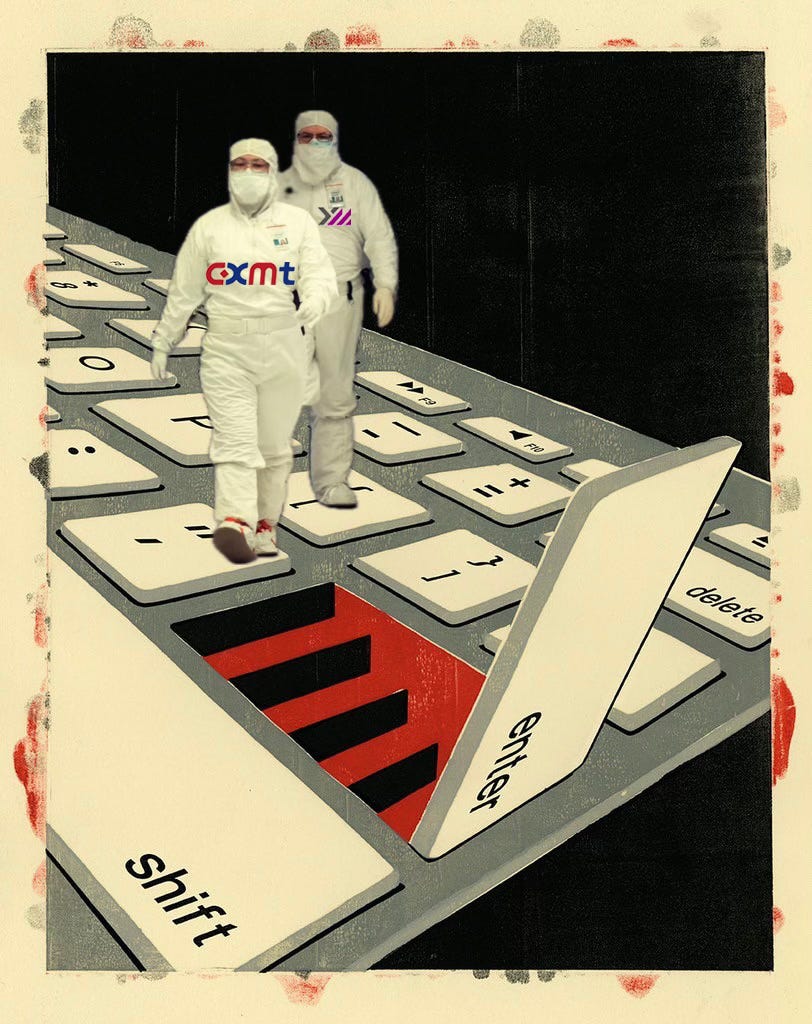
“Necessity hath no law.”
~ Oliver Cromwell
After nearly two decades of watching the tech community treat Chinese tech with scepticism (understandably so), dismissing products as “AliExpress specials” or “Temu chips,” and raising concerns with security backdoors, we’re now seeing an intense reversal. If you’re a consumer wanting to build a PC, you’re practically begging Chinese memory manufacturers to save them from spiralling RAM prices. This represents a massive shift in sentiment that’s happened quickly enough to witness in real time.
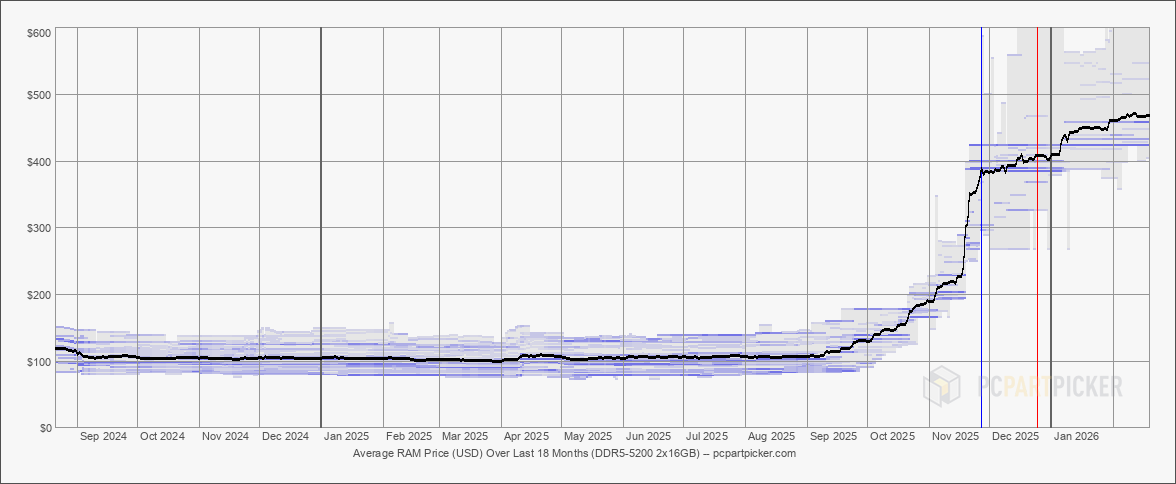
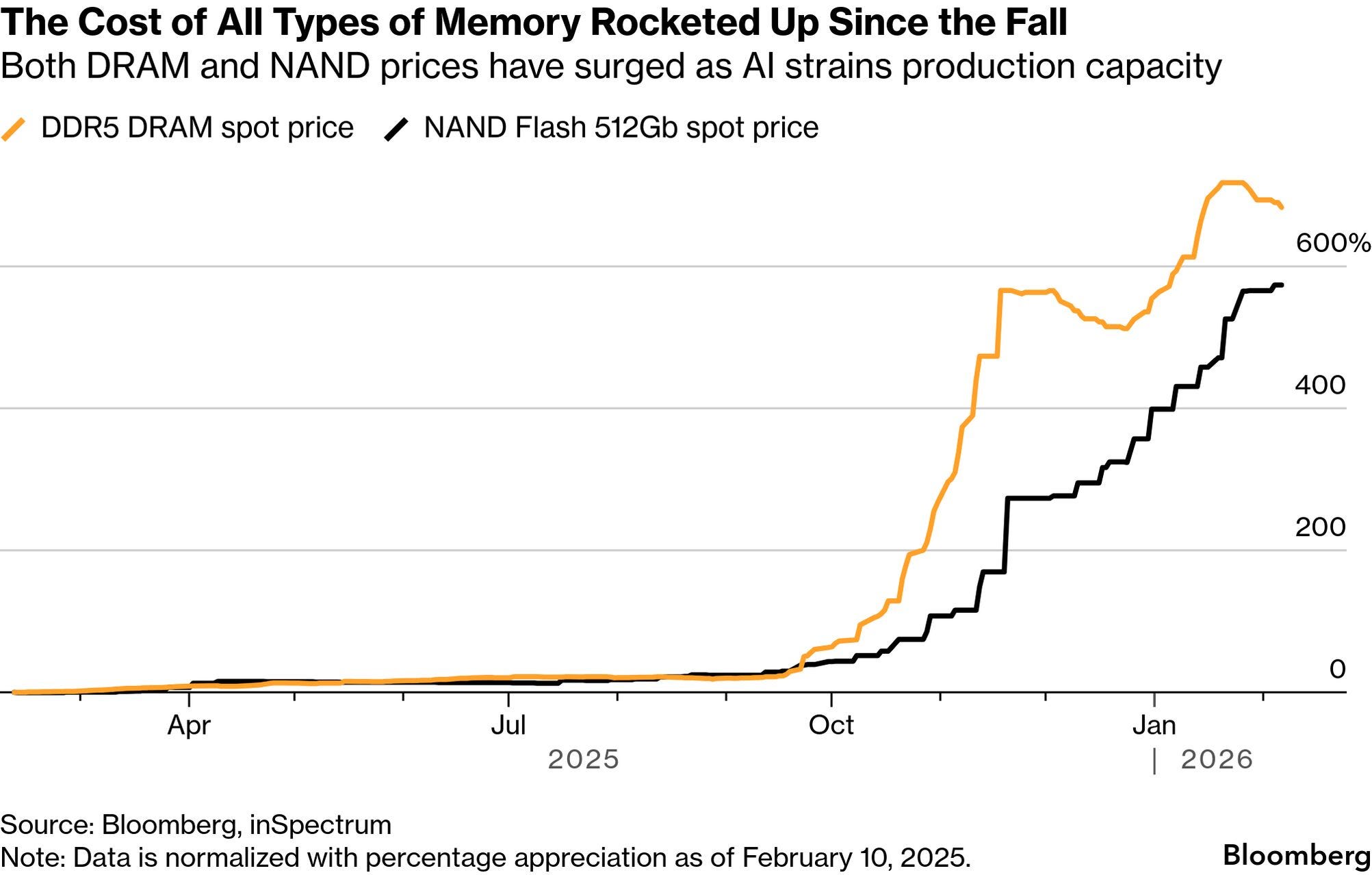
What are the catalysts, one may ask? DDR5 memory prices have quadrupled from September 2025 to February 2026, with some 2x16GB kits jumping from around $100 to nearly $500. The memory market, long controlled by just three players - Samsung and SK Hynix, both in South Korea, and Micron in the USA - has become so expensive that it’s threatening the broader PC ecosystem. Companies that make cases and coolers are facing potential closure because customers can’t afford the RAM to build systems that would go into these products.
This is “leaving the door open”1 for new entrants, and China has two companies positioned to potentially exploit it: CXMT for DRAM and YMTC for NAND flash storage.
Made In China 2025: The Foundation
To understand how we got here, we need to go back to May 2015, when China’s State Council implemented “Made In China 2025,” an ambitious nationwide initiative centred on achieving self-sufficiency in semiconductor manufacturing within ten years. The plan included a remarkably candid admission of China’s weaknesses, acknowledging that the country was “still in the process of industrialization,” with “weak independent innovation capabilities, high dependence on foreign countries for key core technologies and high-end equipment,” and “a lack of world-renowned brands.”
The Western response was critical. The US Treasury Department reserved the right to prohibit Chinese acquisitions in the IC industry. The US Chamber of Commerce questioned the independence of China’s IC fund despite its ostensibly private control. The CFR expressed concern about discriminatory treatment of foreign investment, forced technology transfers, and IP theft.
“[Made in China 2025] caused considerable irritation around the world” and that foreign governments and business associations increasingly see China as a “systemic rival rather than a partner.”
- Analysts at Mercator Institute for China Studies (MERICS)
Mercator Institute for China Studies (MERICS) argues in a 72-page report that the strategy would “probably fail,” citing mismatches between political priorities and industry needs, inefficient funding allocation, and an education system unprepared for training skilled personnel.
These assessments now appear to have significantly underestimated China’s determination and capabilities.
The Rise of CXMT
China initiated several new state-backed manufacturing efforts in 2016. That year saw the birth of Fujian Jinhua and CXMT (Changxin Memory Technologies), both specialising in DRAM production. CXMT started with 10m RMB in initial funding, which then increased to 50m RMB via backing from equipment manufacturer Salcta.
CXMT’s path to competitiveness involved acquiring the remnants of collapsed German memory company Qimonda, purchasing over 10 million technical documents and north of 7,000 patents. Despite these documents being outdated by a decade, they provided both technological foundation and plausible deniability for CXMT’s development efforts. The company also received over $5.5bn in investments from both government and private entities including Xiaomi, Alibaba, and Tencent, at least for the easy numbers I could find.
Their progress in a short space of time has been remarkable. CXMT has ramped production capacity from 20,000 wafers per month in 2020 to ~240,000 wafers per month currently - an increase of 1,200% in just five years.2 To put this in perspective, when OpenAI recently reserved ~40% of global DRAM supply from the big three manufacturers (~900,000 wafer starts per month), CXMT was already producing 26.67% of that amount.
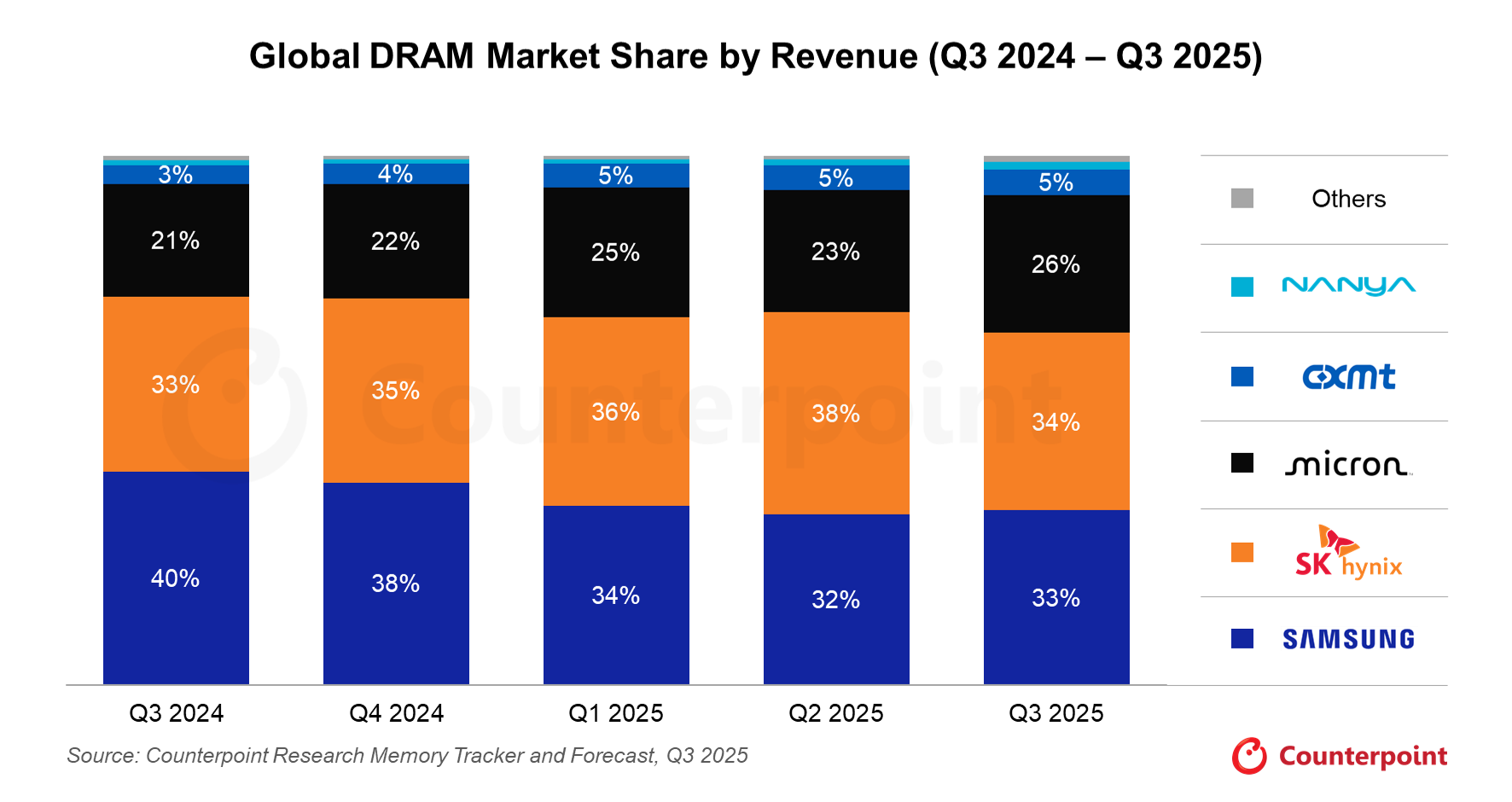
The company has also rapidly closed the technology gap. They trailed competitors by 14 years for DDR3, 8 years for HBM2, 5 years for DDR4, and are now just 3 years behind on LPDDR5X. They’re currently in active development for HBM3, HBM3E, and LPDDR6. CXMT has grown from a miniscule 0.2 market share to in 2021 to 5% in Q3 2025. For an industry that’s notoriously difficult to break into, it’d be unwise to dismiss or downplay China’s progress.
YMTC: Disrupting NAND with Xtacking Architecture
Founded in July 2016 with $24bn in backing, YMTC (Yangtze Memory Technologies) focused on NAND flash memory. The company made its first breakthrough in September 2019 with China’s first 64-layer 3D NAND chip. The unique thing about YMTC that thrusted them to competitiveness was its development of Xtacking architecture, one of China’s first genuinely innovative semiconductor technologies deployed in the modern era.
Xtacking uses wafer-on-wafer 3D bonding to combine two wafers into one product with independent processes - fabricating a periphery wafer an array gate wafer separately, then stacking them. While this approach inevitably ended up costing more and likely reduces yields compared to competitors single-wafer approaches, it enabled YMTC to leapfrog certain development stages. The company skipped 96-layer NAND entirely, jumping directly to 128-layer technology. Astoundingly, Semi Analysis noted YMTC’s 128-layer NAND achieved a die-bit density of 8.48 Gbits/mm2, greater than all competitors at the time.
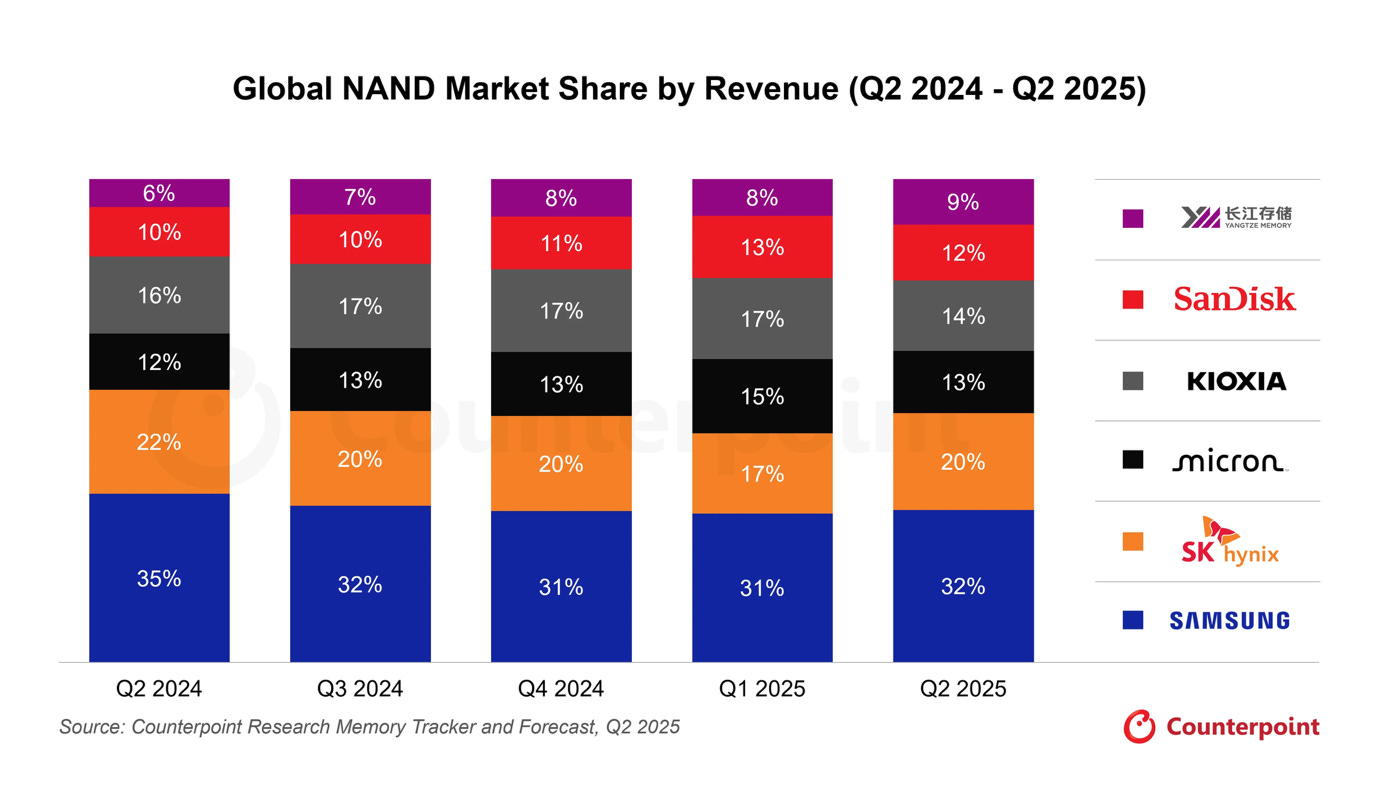
By mid-2022 YMTC began shipping 232-layer NAND, which analysts called the densest NAND available, solidifying the company as a viable global competitor. Despite having below 5% market share against Samsung’s 34%, YMTC’s technological advancements appeared to be outpacing those from Samsung, Western Digital, Kioxia, and Solidigm. Since then, the company has captured 10% of the NAND market.
The Apple Moment + US Intervention
YMTC’s momentum caught the eyes of a major Western brand. Apple began considering YMTC’s 3D NAND flash memory for iPhones sold in China, reportedly at a 20% lower price than alternatives. This represented a potential breakthrough - Apple is large enough to effectively anoint new suppliers in any industry.
But in 2022, US Senators Mark Warner and Macro Rubio called for a public analysis of YMTC’s risks to national security. Within months, the Department of Commerce restricted exports and servicing of equipment used in sub-18nm DRAM nodes and 128-layer or greater NAND flash. YMTC was added to the US entity list, the most comprehensive sanctions designation possible. Apple withdrew its consideration of YMTC as a supplier, and the company immediately laid off 10% of its workforce. As of Feb 17th 2026, Apple are reconsidering partnering with YMTC and CXMT since the Big Three want to play hardball.
The restrictions stopped YMTC’s 232-layer expansion in its tracks. Throughout 2023, the company continued shipping 64 and 128-layer NAND domestically but was hindered by a lack of advanced etching equipment, lithography tools, and maintenance support. When a machine failed at YMTC’s Wuhan plant, the company scrambled for spare parts and leftovers from other fabs because foreign companies - mainly ASML, and a few others - couldn’t provide servicing.
Hello Darkness, My Old Friend: On the DRAM Cartel and Corporate Espionage
This story would be incomplete if I didn’t address corporate espionage and IP issues. Fujian Jinhua, another Chinese DRAM manufacturer founded in 2016, received international attention when the US Department of Justice charged the company, Taiwan’s UMC, and individuals with economic espionage for allegedly stealing knowledge from Micron.
The theft appears to have been real but really unsophisticated. I can’t believe it was this simple. One engineer tipped off Micron by searching Google for instruction on how to wipe a company laptop - not on their personal phone, but on the company laptop itself. Taiwanese officials raided UMC offices and recovered over 900 files of Micron technical documents. Some employees literally hid laptops and USB drives in personal lockers when the raid happened.
Well, you can run but you can’t hide; UMC eventually pleaded guilty in the US and paid $60m in fines. YMTC weren’t miserable alone as they had company; Fujian Jinhua was also added to the entity list, effectively crippling the company. However, in February 2024, Jinhua was cleared of economic espionage charges, with prosecutors unable to demonstrate unlawful acquisition of Micron’s confidential information. Micron and Fujian Jinhua later withdrew all lawsuits against each other.
It’s worth noting the broader context here. The memory industry has an extensive history of corporate espionage, cartel-like collusion, and theft of trade secrets worth billions of dollars. Micron itself has faced convictions for price fixing, as have its two main competitors. Samsung executives have recently been reported leaking advanced DRAM process technology to CXMT. The industry’s track record makes it hard for any company to claim moral high ground when they all engage in espionage in some fashion.
“Fine, We’ll Do It Ourselves”
The US has aggressively used export controls to limit China’s semiconductor progress, restricting access to extreme ultraviolet (EUV) lithography equipment from ASML, the only supplier of several critical fab tools. These restrictions extend to deep ultraviolet (DUV) equipment too. China has also been restricted from purchasing certain Nvidia and AMD GPUs, with special licences rarely granted.
The intention was to slow down China’s progress. The actual outcome may have been different. China has been backed into a corner where export controls restrict both the markets Chinese companies can sell to, and also what they can buy. As a result, China have had their back up against the wall and chose to develop its own tech rather than relying on international suppliers, hence the quote at the beginning of the article. China reportedly completed a working prototype EUV machine built by former ASML engineers in early 2025. While it hasn’t yet produced working chips, unnamed sources predict it will begin production in 2030.
Nvidia CEO Jensen Huang has previously stated that “China has at least 50% or more of some of the leading minds in AI development.” The restriction for China is access to equipment and foreign markets. And those same restrictions appear to be having a time-limited effect as China develops domestic alternatives.
Backdoors and Kill Switches
With Chinese memory potentially entering Western systems, security concerns are unavoidable.
CXMT is primarily a DRAM chip manufacturer. It produces LPDDR4, DDR4, LPDDR5 and DDR5 DRAM dies and packaged devices that are then assembled into DIMMs and other modules, often by third‑party brands. On a standard DDR3/DDR4/DDR5 DIMM, the DRAM chips themselves expose a tightly specified JEDEC interface (address, data, and command pins) and are not designed with custom sideband I/O for covert signalling; adding an obvious extra controller or radio device on the module would change the bill of materials and be visible in any physical teardown. At the circuit level, commodity DRAM is dominated by a dense array of one‑transistor/one‑capacitor cells with relatively small amounts of peripheral control logic for row/column decoding, refresh, and I/O. That does not rule out the theoretical possibility of a foundry‑time Trojan in a DRAM die. Research such as the A2 analog hardware Trojan shows how extremely small, stealthy modifications can be embedded inside a processor’s layout but it does limit the attack surface compared with complex SoCs or controllers, and any added on‑die logic that meaningfully changes behaviour would be a target for specialised reverse‑engineering and failure‑analysis labs. Given ongoing U.S. government scrutiny of China’s semiconductor sector and the competitive interest Samsung, SK hynix, and Micron have in tearing down rival parts, a crude or easily observable backdoor in DRAM or on a DIMM would face a high risk of eventual discovery and reputational damage for the vendor.
By contrast, SSDs and other storage devices include fully programmable controllers with complex firmware, rich protocol support (e.g., NVMe), and direct access to host memory via DMA, which makes them a much more natural locus for sophisticated backdoors than raw DRAM or NAND dies. Public reporting on the Equation Group’s hard‑drive implants and recent research on malicious or weaponised NVMe SSDs both illustrate how controller‑level firmware can be used to persist malware, exfiltrate data, and even hijack the host operating system, all while remaining opaque to most conventional security tools. For that reason, independent experts typically view storage controllers and their firmware as a higher‑risk component than commodity DRAM chips themselves when assessing hardware backdoor scenarios.
Market Competition and Consumer Pricing
Despite several companies using CXMT and YMTC products, these aren’t widely advertised in Western markets. In order to find them, researchers had to crawl through motherboard QVLs (qualified vendor lists) to identify which products use CXMT DRAM. YMTC’s NAND appears in products from Acer, HP, Huawei, Kingston, Lexar, and Team Group, among others.
Pricing data suggests competitive pricing. A Kingbank 16GB DDR4 4-3600 kit using CXMT modules was priced at $106 versus a $140 market average, which is nearly 25% cheaper. Fanxiang SSDs using YMTC’s NAND were priced 12-16% below market averages, with the $TB offering showing the largest gap at $380 versus a $480 average.
The FT and other outlets suggest CXMT and may have achieved rapid market growth by flooding the market with underpriced chips, enabled by seemingly limitless government funding that allows the company to ignore profits in favour of market share gains. Taiwan’s Wealth magazine reported that DDR3 and DDR4 modules from CXMT appeared on Taiwanese online markets at prices sometimes half that of competitors.
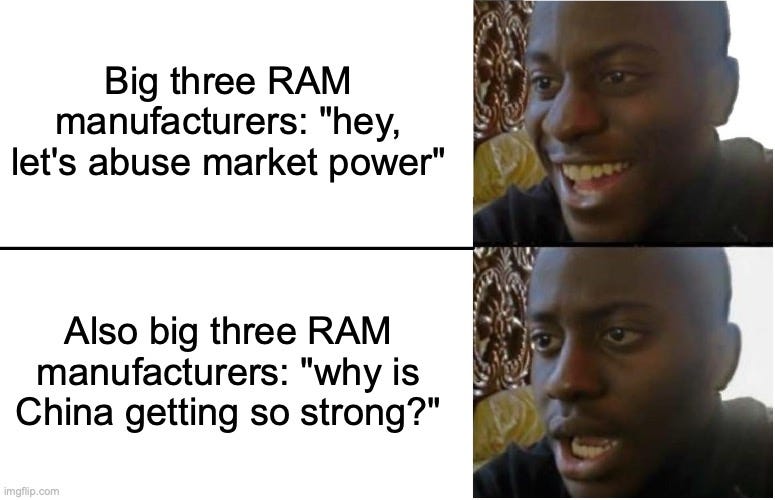
Critics call this unfair, which is a bit rich from them. The memory industry has spent decades engaging in price fixing and collusion. In an industry dominated by manufacturers that make quarterly statements about prioritising profit margins while abandoning some product lines entirely, you can see how government subsidised competition might not seem like a bad thing from a consumer perspective. You can’t spell drama without DRAM.
The idea that China won't eventually produce the most advanced chips, aircraft, gas turbines etc is a fools errand. They will. And they'll do it faster now it's seen as existential. It doesn't stop the West (mainly the US) from doing it and we need to but the future price point of these technologies will for sure come under pressure.
The Hypocrisy Question
Throughout this story runs a thread of hypocrisy that’s impossible to ignore. The US government criticizes Chinese semiconductor companies for having government backing and connections to military applications. Yet the US owns 10% of Intel and funnelled tens of billions of dollars in grants and tax breaks into various semiconductor projects. Micron receives government support and supplies the US military. Nvidia has connection to the military-industrial complex through Palantir and drone technology. Don’t you love when the government of “small government” and “free markets” decides consumers can’t buy computer parts from a specific country because it might weaken the monopolies on that product?
In 2022, the year Senators Warner and Rubio called YMTC into question for national security reasons, Micron made its largest lobbying contributions in company history - over $4m spent on lobbying with ~50 lobbyists hired. Micron has donated to Warner, Trump, and Harris, and made millions in contributions to Trump’s inauguration.
When the US International Trade Commission expressed concern about China’s self-supplying silicon potentially reducing multinationals’ long-term viability in China, it was stating the obvious: countries want [AI] sovereignty. The criticism of China’s “state capitalism” playbook in the tech industry comes at a time when more US taxpayer money than ever flows to tech companies that decreasingly sell to consumers, to the extent that people now appoint their leaders to government positions.
This isn’t to dismiss legitimate concerns about IP theft, forced technology transfers, or security implications as they’re all valid worries. However, it’s extremely difficult to separate genuine security considerations from protectionism designed to maintain the profitability of corporations that donate heavily to politicians.
Recent Developments and the Path Forward
CXMT and YMTC continue advancing. CXMT began phasing out DDR4 in May 2025, prioritising resources towards DDR5 and HBM development aligned with AI and cloud infrastructure demands. CXMT is planning an IPO on on the Shanghai Stock Exchange, and raise funding of ~20 billion-to-40-billion-yuan ($2.8bn - $5.7bn) at a ~300bn yuan ($42bn) valuation.
YMTC has re-entered the market forcefully since releasing Xtacking 4.0 (which initially contained 160 active layers, down from 3.0’s 232 layers, but achieved without foreign support and against active US opposition). The company reportedly outsells Samsung domestically and is aggressively expanding capacity, with market share growing from 6% in Q2 2024 to 9% in Q2 2025. Reuters reported that YMTC is considering shifting some NAND production to DRAM to enter the HBM market. TrendForce claims YMTC’s rapid growth “is expected to boost its market share significantly, reshaping the global landscape.” YMTC is also consdering an IPO in mainland China in 2026 at a valuation of 200 billion yuan (~$28bn) to 300 billion yuan ($42bn). Details of YMTC and CXMT’s IPOs are still preliminary and subject to change, according to the people. The aim of the IPOs are to raise funds for more fabrication plants.
Is It Possible That We’ll See a DeepSeek Moment?
The DeepSeek moment in AI software came when a DeepSeek unexpectedly released competitive models that challenged assumptions about the necessity of expensive hardware and massive budgets. Will Chinese memory manufacturers walk through the open door and deliver a similar disruption?
The conditions are aligning, hence the deliberate title choice. CXMT has already captured 5% global market share in just ten years while closing the technology gap to three years behind incumbents. YMTC holds 10% of the NAND market with genuinely innovative architecture. Both companies have access to essentially unlimited government funding, a supportive billion-person domestic market, and world-class engineering talent that is only limited by temporary equipment access which China is actively working to overcome.
Most importantly, there’s been a dramatic shift in consumer sentiment from scepticism about Chinese silicon to one of ‘desperate hope’ for alternatives to the incumbent three-company oligopoly. When users are willing to overlook previous concerns about Chinese technology because they’re being priced out of the market by coordinated price increases from established players (who are reacting to the DRAMpant demand in the AI data centre buildout), that represents a genuine market opening.
CXMT and YMTC are not without its challenges. They’re restricted from accessing the most advanced manufacturing equipment. They trail in process technology. Their yields are uncertain and difficult to verify in their relatively closed operational environment. They face scepticism about security. But the incumbent memory manufacturers also faced and continue to face significant problems: convictions for price fixing, collusion, and anti-competitive practices, combined with a current strategy of maximising margins at the expense of customer affordability.
If CXMT and YMTC can accurately identify the gap in the consumer market and the sentiment shift, especially in Western markets, they may establish a foothold. In the hardware industry, you often need only one generation of satisfied customers to build loyalty. If the product works and the price is right, customers will return.
Let’s say hypothetically that the “will we see a DeepSeek moment” question has been answered and it does happen - then there’s also the question of ‘will this fundamentally reshape the memory chip landscape’ or ‘will it be just another fad like the DeepSeek AI model moment?’ Even if it does happen, how much of it will be attributable to CXMT and/or YMTC flooding the memory chip market with cheap hardware versus something else like AI capex not delivering the expected ROI? I say this because even though the release of DeepSeek R1 model initially sent tech stocks tumbling at the start of 2025, fast forward 13 months later to the present day, no one really uses DeepSeek as much as the US-based AI models. The impact of DeepSeek’s initial release on AI model costs faded relatively quickly, and as a result, their traffic declined as SemiAnalysis noted:
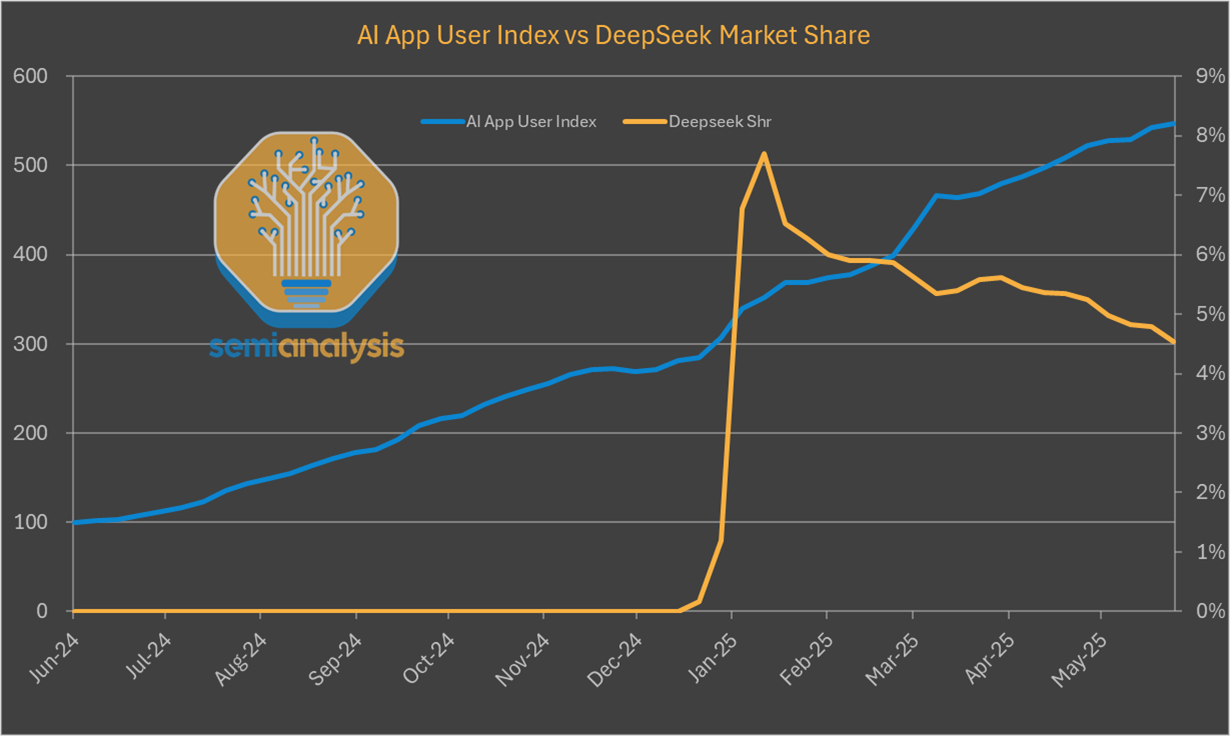
Consumer app traffic to DeepSeek spiked following release, resulting in a sharp increase in market share. Because Chinese usage is poorly tracked and Western labs are blocked in China, the numbers below understate DeepSeek’s total reach. However, the explosive growth has not kept pace with other AI apps and DeepSeek market share has since declined.
The answer to whether we’ll see a DeepSeek moment with memory likely depends on factors beyond pure technical capability. Can these companies navigate export controls and develop domestic tool chains? Can they scale production to meaningfully impact global supply? Can they overcome lingering security concerns, whether founded or not? And perhaps most importantly, will Western governments allow Chinese memory [from CXMT and YMTC] to enter their markets, or will they implement restrictions similar to those hobbled Fujian Jinhua and YMTC’s initial momentum? If the answer to all the aforementioned questions ends up being yes, the memory chip oligopoly may be trouble if the impact lasts long enough.
For this “DeepSeek” moment within AI hardware to truly happen, CXMT (and YMTC) would have to significantly ramp up production capacity in a short period of time. Considering they only started DRAM production in 2021, they were growing rapidly but the US placed export restrictions on them and now they don't have the tools required to build new factories. Their growth stopped. They're currently figuring out how to make their own tools right now. The fact that China is being hampered by export restrictions and similar trade sanctions is precisely the reason why I think China memory cannot be the “EV car” moment.3 They cannot scale capacity due to the restriction placed for manufacturing tools. They need to figure out how to make the entire manufacturing tools first. As soon as they able to do it, they can flood the market and destroy the trio DRAM cartel.
Consumers who want to build PCs want this to happen but they may not get their wish. For some reason, they like to think companies will act altruistically when there is a problem with the markets. There is zero reason or incentive, short or long-term, for CXMT to not target consumers with slightly lower prices but still maximzie profits. The memory is on par with other major brands. But CXMT figured out they could charge more by allocating 20% of its DRAM capacity to HBM, so the price delta between them and branded options is now negligible. Let’s be honest, CXMT were never going to say no to an opportunity to increase revenue.
Chinese memory manufacturers are no longer being treated like a distant threat or a joke. They’re producing competitive products, capturing meaningful market share, closing technology gaps at remarkable speed, and benefitting from a consumer base increasingly frustrated with the status quo. Whether that translates into a true disruption of them memory market - a DeepSeek moment where assumptions about the necessity of the big three are suddenly challenged - remains to be seen. But for the first time in decades, the three company memory oligopoly faces genuinely competitive pressure from outside challengers with the resources, talent, and determination to succeed.
And from a consumer perspective, more competition bringing new supply into a market characterized by price fixing and coordination might not be the worst thing in the world, regardless of where that competition originates.
On the meaning of the title: In motor racing, “leaving the door open” is an idiomatic expression that means a defending driver (Samsung, SK Hynix, Micron) has taken a corner too wide, or left a gap on the inside, thereby providing an opportunity for the car (or in this case, memory chip companies) behind (such as CXMT, YMTC) to overtake. It implies a defensive error where the driver fails to secure their position, allowing a competitor to dive inside or alongside them.
Estimates were as high as 280,000 wafers per month by the end of 2026, according to various articles. Due to certain Chinese media companies being owned by Chinese tech companies (mainly conflicts of interest - South China Morning Post has been owned by Alibaba since 2015), and closed reporting more generally, obtaining official numbers wasn’t easy.
If the US dropped trade barriers on China, you'd see the domestic US car industry implode pretty quickly. We’ve seen it happen with Europe already, especially with lower-priced EVs.
Banger 💥